Introduction
There is a line spoken by an ENT consultant that has stayed with me for many years: “Without your medical file you don’t exist within this environment.” The comment was casual, but it 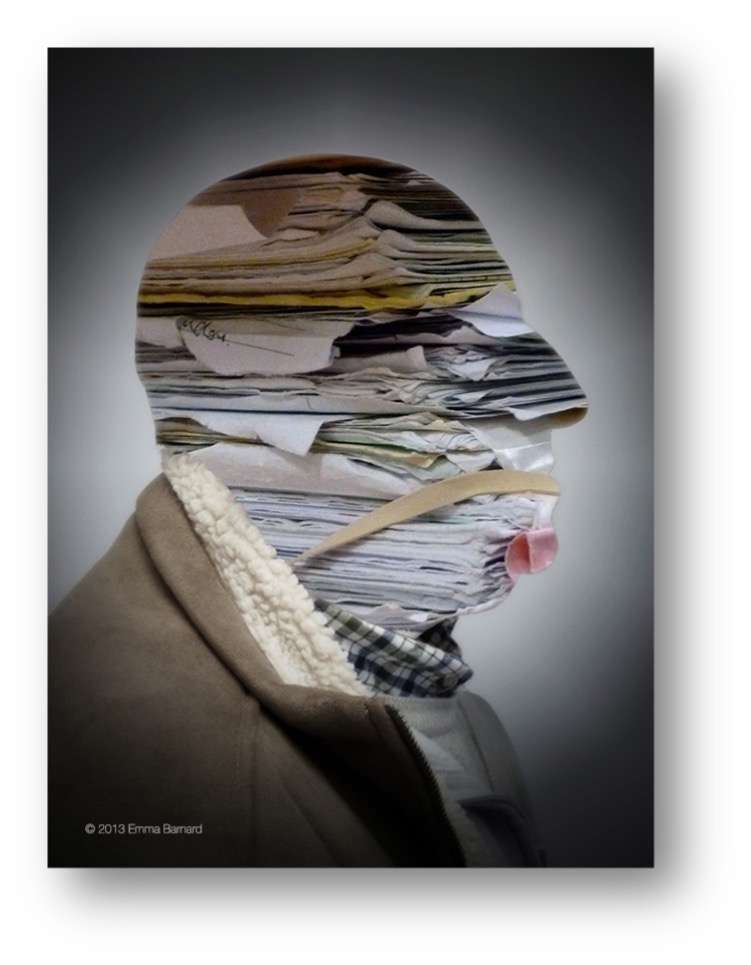 resonated with something I had long sensed — that within the medical setting, the individual can often be reduced to a case, a file, a set of notes. The person, with all their complexity, vulnerability, and lived experience, risks becoming invisible.
My practice as an artist for the past fifteen years has been a sustained attempt to challenge and reframe this reduction. Working collaboratively with doctors, surgeons, and patients, I aim to give voice, image, and presence to those who feel unseen in the clinical encounter. In doing so, I am also exploring how art can sustain hope: hope for patients facing illness, hope for doctors navigating immense pressures, and hope for the healthcare system as it seeks to remain humane.
This essay reflects on that practice. It will explore the medical context and the notion of the medical gaze as theorised by Michel Foucault; introduce key projects such as Patient as Paper and Primum Non Nocere; and consider how collaboration between artist, doctor, and patient creates new spaces for dialogue. Ultimately, I argue that art has a unique capacity to restore hope in healthcare, precisely because it insists on recognising the humanity behind the file.
Context: Medicine, Art, and the Medical Gaze
Modern medicine is extraordinary in its technical capacity. It diagnoses, treats, and heals with a precision that would have been unimaginable only a century ago. And yet, the very systems that make this possible often sideline the patient’s own voice.
Michel Foucault, in The Birth of the Clinic (1973), described how the rise of modern medicine brought with it a new way of seeing: the medical gaze. He wrote:
“The patient is reduced to the passive role of the object of knowledge; the medical gaze penetrates beneath the surface of the body to read its hidden truths.”
And further: “The gaze that sees is a gaze that dominates.”

This concept captures what many patients continue to experience: the feeling of being studied, scrutinised, and categorised, rather than truly listened to. Their subjectivity is effaced; they become cases rather than persons. My own encounters with patients confirm this. One woman who had undergone a laryngectomy told me, heartbreakingly:
“I felt as if my personality had been taken away from me because I could not express myself anymore.”
Her words exemplify the double silencing that can occur: the literal loss of voice after surgery, and the figurative silencing within the medical system.
It is in this context that I approach my practice. I am not a clinician, but an artist. My role is not to diagnose, but to listen and to create. Through visual and participatory work, I aim to opena space where patients can articulate what is otherwise unheard, and where doctors can reconnect with the humanity of their patients.
Hope in Healthcare
Before turning to specific projects, it is worth reflecting briefly on the concept of hope itself.
Hope is not the same as optimism. For many patients, particularly those with chronic or life-limiting conditions, hope is not about cure. Rather, it is about resilience, meaning, and dignity in the face of uncertainty. For doctors, hope involves a delicate balance: sustaining possibility without offering false promises. And for artists like myself, hope is often about creating a visual language that allows patients to speak in ways beyond words.
In all these senses, hope is relational. It exists not as an abstract idea, but in the spaces between people — in the dialogue between doctor and patient, in the collaborative act of making art, in the simple acknowledgement that a person’s story matters.
Patient as Paper: Offering a Voice through Image
The project for which I am perhaps best known is Patient as Paper, developed with ENT (Head and Neck) surgeon Mike Papesch FRACS. After discussion about their experience, patients are free to inscribe, annotate, draw, or mark over their portraits.
The results are extraordinary. Some patients draw areas of pain in bold, vivid colour, some leave sections blank, using absence as a form of presence. Each silhouette becomes a portrait not of anatomy, but of lived experience.
Patients frequently tell me that the process helps them feel “seen” in a way that medical consultations do not. As one participant explained, marking the paper gave them a sense of authorship over their illness story. They became active narrators rather than passive subjects.
For clinicians, too, the works are often revelatory. Surgeons have told me: “I never realised this is what my patient was carrying.” Seeing the patient’s experience externalised on paperreframes the relationship. The file becomes more than data; the patient becomes a person again.
In this way, Patient as Paper generates hope not only for patients but also for doctors. For patients, it affirms their voice. For doctors, it offers a reminder of the humanity at the heart of medicine — a vital counter to burnout and compassion fatigue.
Primum Non Nocere: The Fragility of Hope in Surgery 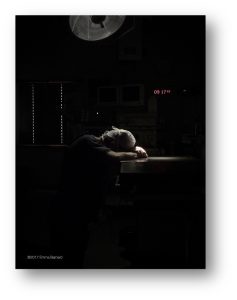
Another strand of my work is the series Primum Non Nocere — Latin for “First, do no harm.” Here I turned my attention to the world of the surgical theatre.
In this series, I sought to visualise the tension inherent in surgery: the immense trust placed in the surgeon, the weight of responsibility carried, and the fine line between healing and harm. Images are often shadowy, ambiguous, suggesting both the precision and the risk of surgical practice.
Hope here is fragile, yet it is palpable. It lies in the trust that patients place in their surgeons, and in the surgeons’ own commitment to care despite the pressures they face. By creating artworks that dwell in this tension, I aim to honour both perspectives — patient and doctor — and to open a dialogue about the ethical and emotional dimensions of surgical practice.
Triangular Dialogue: Artist, Doctor, Patient
Across these projects, a theme emerges: the creation of a triangular dialogue between artist, doctor, and patient.
- The artist acts as mediator, witness, and translator, holding the patient’s story in visual form.
- The doctor provides medical truth, but also carries the responsibility of sustaining hope.
- The patient brings vulnerability, but also creativity and agency.
When these three roles intersect, something powerful happens. Patients feel less isolated, doctors reconnect with empathy, and art provides a space where difficult emotions can be expressed without judgment.
Of course, such work is not without challenges. Ethical considerations are paramount: ensuring consent, avoiding exploitation, respecting the patient’s own interpretation of their art. Yet when done carefully, the triangular dialogue creates precisely the conditions in which hope can flourish.
Reflections from Patients and Clinicians
The most powerful evidence of this comes not from me, but from those who have participated. Patients have described feeling “lighter” after externalising their experiences onto paper. One said: “It feels like I’ve finally been listened to.”
Clinicians, too, reflect on the impact. One surgeon admitted that seeing a patient’s artwork changed the way he approached consultations. Another commented on how art helped to “re-humanise” the medical encounter.
These reflections suggest that hope is not something abstract or distant. It is generated in very practical ways — through listening, witnessing, and creating spaces where stories can be told.
This drawing, created by a doctor in a busy ENT outpatient clinic, shows a generic profile, on one side there are tick marks that symbolise completed tasks and visible progress. Inside the profile, however, is another expression—one of sadness—encircled by question marks. It reflects the doctor’s realisation that although care may appear complete from a clinical standpoint, they often carry unseen uncertainty and worry beneath the surface.
Audience Reflection: Where Do You See Hope?
In presenting this work, I often invite audiences to pause and reflect. Where have you seen hope — fragile or strong — in healthcare, art, or in your own life?
The responses are varied: a nurse recalling a patient’s gratitude; a patient remembering a doctor’s kind word; an artist describing the act of making as a lifeline. These reflections remind me that hope is not rare or inaccessible. It is present, though often hidden, waiting to be recognised.
Conclusion: Cultivating Spaces for Hope
To conclude, I return to the beginning: the idea that without a file, a patient does not exist. My work argues precisely the opposite: that the person exists fully, richly, beyond the file, and that art can help reveal this truth.
Hope in healthcare is not naïve optimism. It is the courage to face uncertainty, the dignity of being seen, the compassion of listening. It is relational, emerging in the spaces between people.
Through projects like Patient as Paper, Dry Mouth Dialogue: an artistic enquiry into xerostomia and Margin: where clinical boundaries meet lived experience, I have witnessed how art can restore hope by re-humanising the medical encounter. By creating a triangular dialogue between artist, doctor, and patient, we can move beyond reductionist files and diagnoses, and towards a more holistic vision of care.
I leave you with a question:
How might you cultivate spaces for hope — however small — in your own work, your practice, or your life?
Emma Barnard. MA (RCA). HVHF Artist in Residence.
For more information about my work and to sign up to my newsletter:
https://www.instagram.com/emmabarnardartwork/
References
Fancourt, D., & Finn, S. (2019). What is the evidence on the role of the arts in improving health and well-being? Health Evidence Network synthesis report, No. 67. WHO Regional Office for Europe. ISBN-13: 978-92-890-5455-3. NCBI
Foucault, M. (1963). Naissance de la clinique : une archéologie du regard médical. Presses Universitaires de France.
Foucault, M. (1973). The Birth of the Clinic: An Archaeology of Medical Perception (A. M. Sheridan, Trans.). Tavistock Publications. (Original work published 1963) Wikipedia+2Cambridge University Press & Assessment+2
Hinsliff-Smith, K., McGarry, J., & Ali, P. (Eds.). (2022). Arts Based Health Care Research: A Multidisciplinary Perspective. Springer. SpringerLink
Daykin, N. (2021). Arts, Health and Well-Being: A Critical Perspective on Research, Policy and Practice. Routledge. Taylor & Francis
Boyce, M., Bungay, H., Munn-Giddings, C., & Wilson, C. (2018). The impact of the arts in healthcare on patients and service users: A critical review. Health & Social Care in the Community, 26(4), 458-473. https://doi.org/10.1111/hsc.12502 Wiley Online Library
Kaptein, A. A., Hughes, B. M., Murray, M., & Smyth, J. M. (2018). Start making sense: Art informing health psychology. Health Psychology Open, 5(1). SAGE Journals